Cold plasma offers a wide range of applications of interest to different industrial
sectors. The research group Cold Plasma Physics for Advanced Technologies develops
and applies plasma-based technologies in areas related to energy, industrial
decarbonisation, and the modification and treatment of materials, with experience in
adapting these technologies to applied and pre‑industrial contexts.
Plasma catalysis and plasma-assisted chemistry
The group works on the development and operation of plasma reactors capable of
carrying out chemical reactions of interest at atmospheric pressure and, when
required, at reduced pressures. In particular, the group operates dielectric barrier
discharge (DBD) reactors and packed‑bed reactors, in both planar and cylindrical
configurations, allowing the study and optimisation of a wide range of operating
conditions.
These systems are used to promote chemical reactions with competitive energy
efficiencies, especially in processes where plasma activation enables lower operating
temperatures or non‑conventional reaction pathways.
FOTO
The group has experience in:
- Synthesis of value‑added compounds, such as alcohols, formaldehyde and
ammonia - Hydrogen production using plasma‑assisted processes
- CO₂ conversion and valorization, including dry and wet methane reforming
These research lines are relevant for industrial sectors aiming to reduce emissions and
to make use of low‑grade or waste energy streams.
Plasma-based treatment and modification of materials
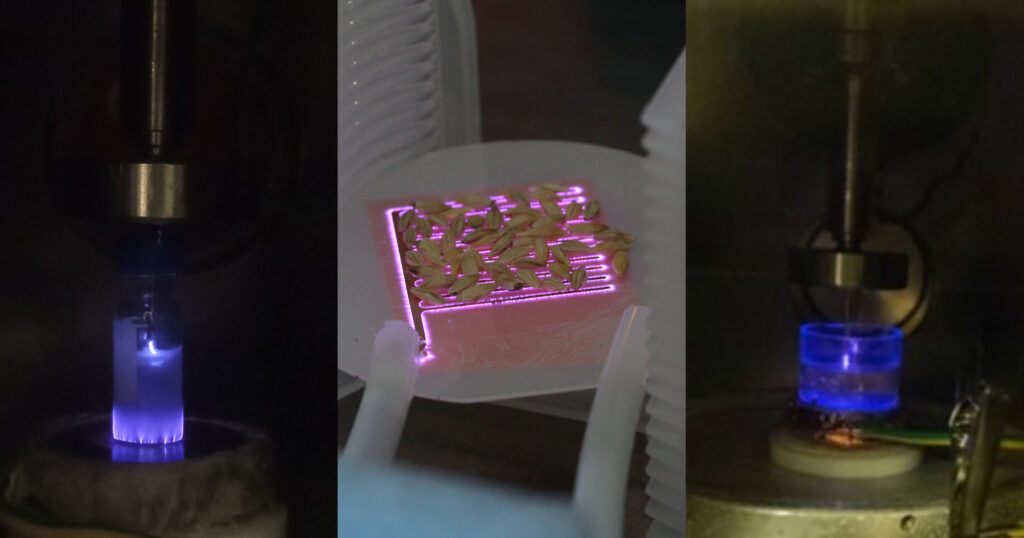
The group operates several plasma reactors at atmospheric and low pressure,
including DBD systems, RF plasmas, plasma jets and gliding arc configurations,
designed for the surface treatment of both inert and biological materials.
These technologies enable controlled modification of surface properties without
significantly affecting the bulk characteristics of the material.
Surface modifications include adjustment of hydrophobic or hydrophilic behaviour,
increase in surface energy, improvement of adhesion, wettability and interfacial
compatibility, surface cleaning and activation, introduction of specific functional
groups at the surface.
The group has experience in:
- Plasma treatment of seeds at atmospheric pressure
- Activation and treatment of catalytic materials
Plasma treatment of water and liquid media
The group also develops plasma-based approaches for the treatment of water, liquids
and gels using different reactor types, including plasma jets and pin‑to‑plate systems.
These configurations make it possible to work with fluids of different viscosities and to
adapt the reactor design to the specific application.
These techniques allow:
- Removal of contaminants, including emerging pollutants
- Generation and incorporation of reactive species and radicals in liquid media
The group has experience in the study of these processes and in adapting plasma
systems to different experimental conditions and environmental applications.