Add-Plasma focuses on the study and development of cold plasma technologies as innovative and sustainable tools for scientific experimentation. Our research combines physics, chemistry and materials science to explore new methodologies and applications based on plasma processes.
Our Research Areas
The research group Add-Plasma: Cold Plasma Technology for Advanced Technologies, is devoted to the study and characterization of cold plasma and their applications. These include plasma-assisted chemical processes, surface modification and functionalization of materials, as well as plasma–surface interaction phenomena. These research activities are carried out from both a fundamental and an applied perspective. On the fundamental side, efforts are focused on the determination of the key physical parameters governing plasma discharges—such as electron energy, plasma density, and reactive species generation—while, from an applied standpoint, the group explores their scalability and integration into industrial processes. The team is composed of experts from diverse fields, including physicists, chemists, and materials engineers.
Non-thermal plasmas constitute a highly promising tool for the development of sustainable technologies, owing to their low energy consumption, negligible generation of hazardous emissions, capability for decentralized operation, and compatibility with renewable energy sources.
The main research lines of the Add‑Plasma Group include:
• Design and development of advanced plasma reactors
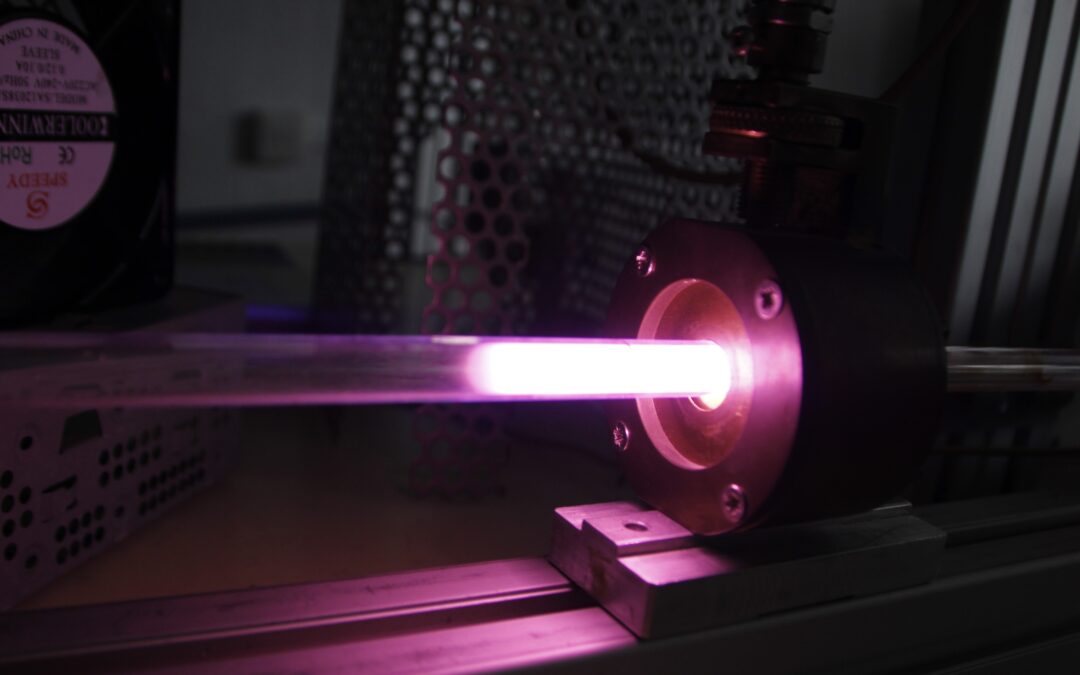
Design, construction, and commissioning of plasma reactors with tailored operational properties constitute a core activity of the group. A wide range of plasma systems has been developed, including planar and cylindrical DBDs, plasma torches, packed‑bed reactors, radio‑frequency discharges, gliding arcs, and DC discharges.
Current work focuses on the development of micro‑plasma reactors. The laboratory infrastructure enables operation with multiple gases and across a broad pressure range, from atmospheric conditions down to 10⁻⁵ mbar. Discharge characteristics, particularly plasma current, can be precisely adjusted to meet the requirements of specific processes. Significant expertise has also been acquired in scaling up plasma reactors for industrial implementation.
• Plasma‑assisted chemical processes
Research activities include plasma‑driven synthesis of high‑value chemicals such as NH₃, H₂, and COH₂. Additional lines address the removal of air contaminants (VOCs), CO₂ conversion and valorization, and methane reforming processes enabled or enhanced by non‑thermal plasma operated at atmospheric pressure.
• Water and seed treatment
The group investigates the degradation of emerging water pollutants and the production of plasma‑activated water (PAW) enriched in reactive species. Plasma treatments are also applied to seeds to enhance germination performance and reduce abiotic stress in various crop species, including barley, quinoa, and cotton.
• Plasma–surface interaction studies
Research includes the analysis of plasma interactions with diverse surfaces, ranging from inert materials to biological substrates. Special attention is given to seed treatments, with the aim of enhancing germination performance and reducing abiotic stress in various crop species, including barley, quinoa, and cotton.
Link to Papers
Explore our latest scientific publications and research outputs.
Link to Proyects
Discover our latest projects and developments.